Work on a game with Claude
Card-a-mon can do more than lay out cards. In the editor, Claude, an AI model by Anthropic, works on your game with you: you ask, in the chat beside the cards, and it changes them while you watch, checks them as they will print, and has bots playtest the game before it reaches the table.
This page follows one game: Who Eats Whom? Pond Chain, a ten-card game about a pond's food chain for pupils aged 8 to 11.
What you need
A Card-a-mon account, and some AI credits: Claude is paid for in them, one credit to a cent. The Maker plan includes 300 a month and Pro 1,200, and packs from €5 work on any plan, the free one included. Every answer says what it cost; see Plans and credits.
Everything Claude changes is an ordinary project. You can change any of it in the editor by hand, export it, print it, or ignore Claude altogether.
1. Tell it about the game
Claude works from the project's cards and from what you tell it about the game. Put that in Game, at the top of the editor: what the game is about, and its rules, how it is played among them. The chat reads them before it changes a card, and a playtest is played by them.
2. Change it by asking
Open the Chat with Claude tab beside the cards and ask for what you want, the way you would ask a person. Claude reads the project, sees the card and field you have picked, and changes the cards while you watch. Some things to ask:
- “Make the titles a little bigger.”
- “Fill in the flavour text of every card that has none.”
- “Add five more cards that fit the rules.”
- “Put an icon from the library on every resource.”
- “What would this cost to print?”
The pond game's cards had an empty round badge in the corner. Asked to put each card's place in the food chain in it, and to give the small creatures the same dark title bar as the others:
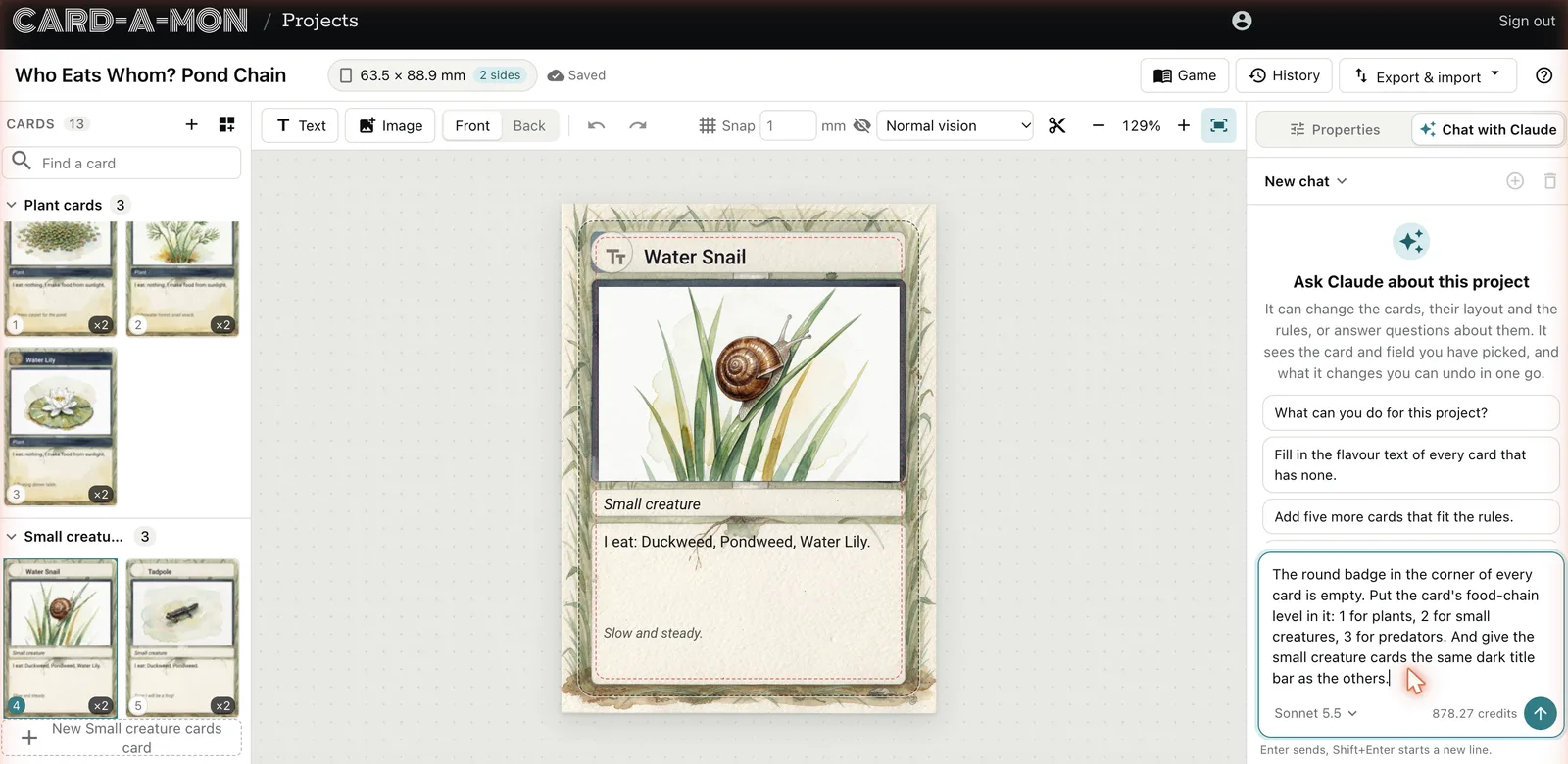
Ten cards changed at once, in about twenty-five seconds and for 40.23 credits. Claude looks at the cards afterwards, as they will print, and says what it noticed: here, that some titles were a little short of the contrast they should have.
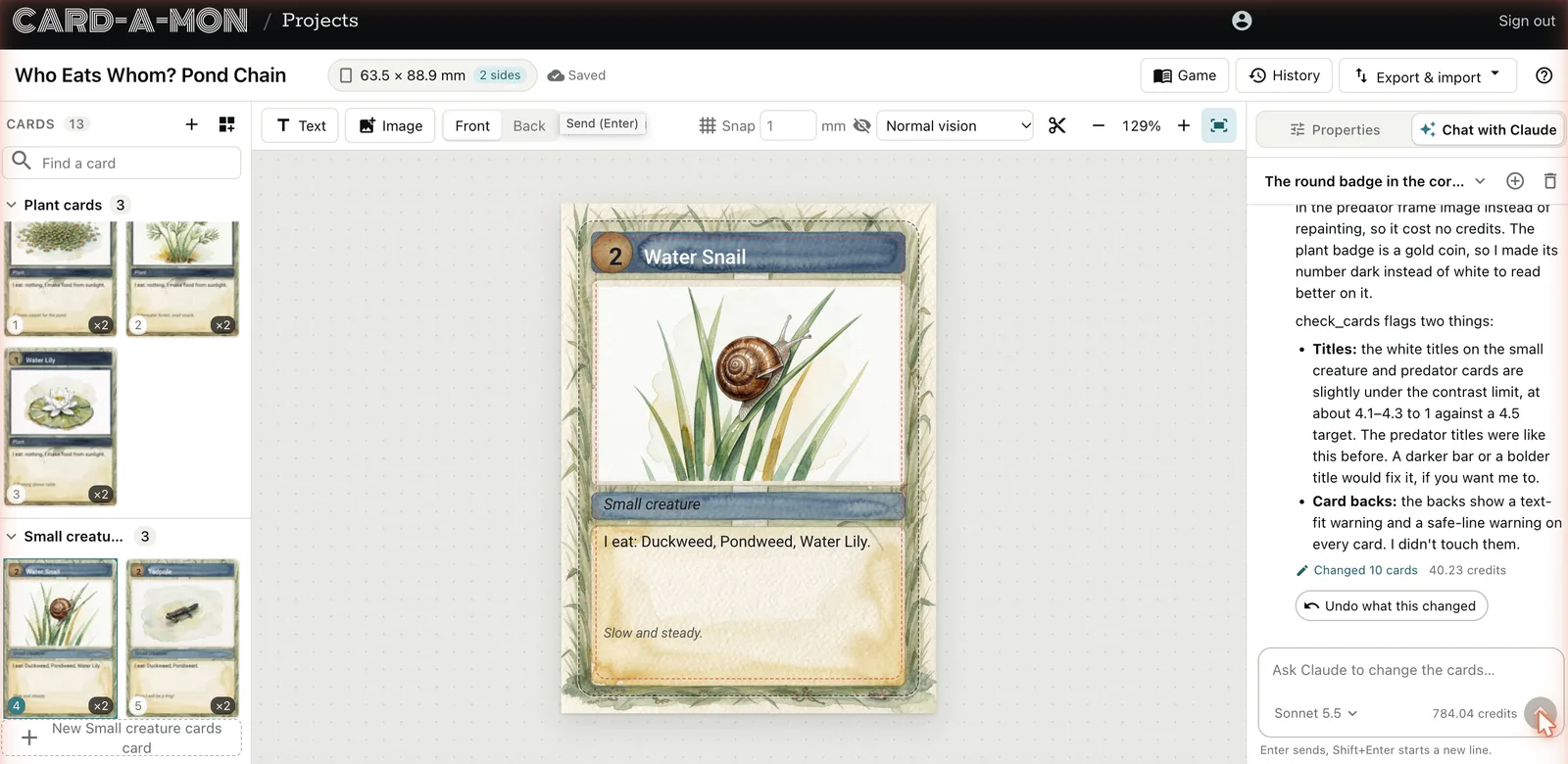
Whatever one message changes, Undo what this changed takes back in one step, and History keeps the earlier versions of the cards. While Claude is working the cards are locked; you can edit them again as soon as it has answered. Every answer shows what it cost under it.
3. Playtest it
Before a game reaches the table, ask the same chat for a playtest. The pond game was asked: “Playtest the game with 3 players. How long does a game take, does going first help, and is any card too strong or too weak?”
Claude writes the game's rules as a program, then bots play it many times — a thousand games here — in your own browser. Claude reads one of the games move by move to check it follows the rules as written, and says where your rules leave something open.
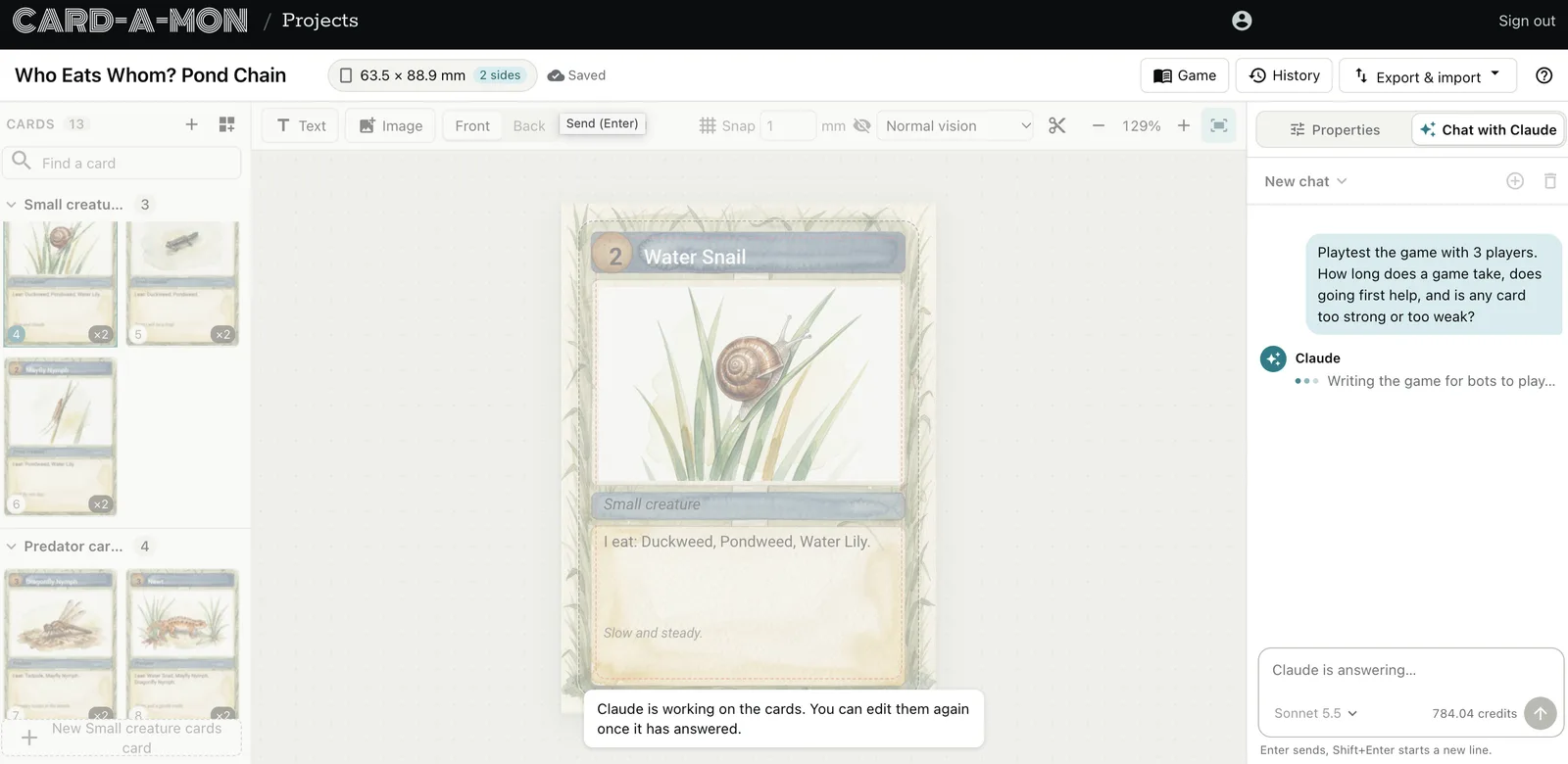
The pond game's playtest took under two minutes. The answer says how long a game lasts, whether a seat has an advantage, and how strong each card is:
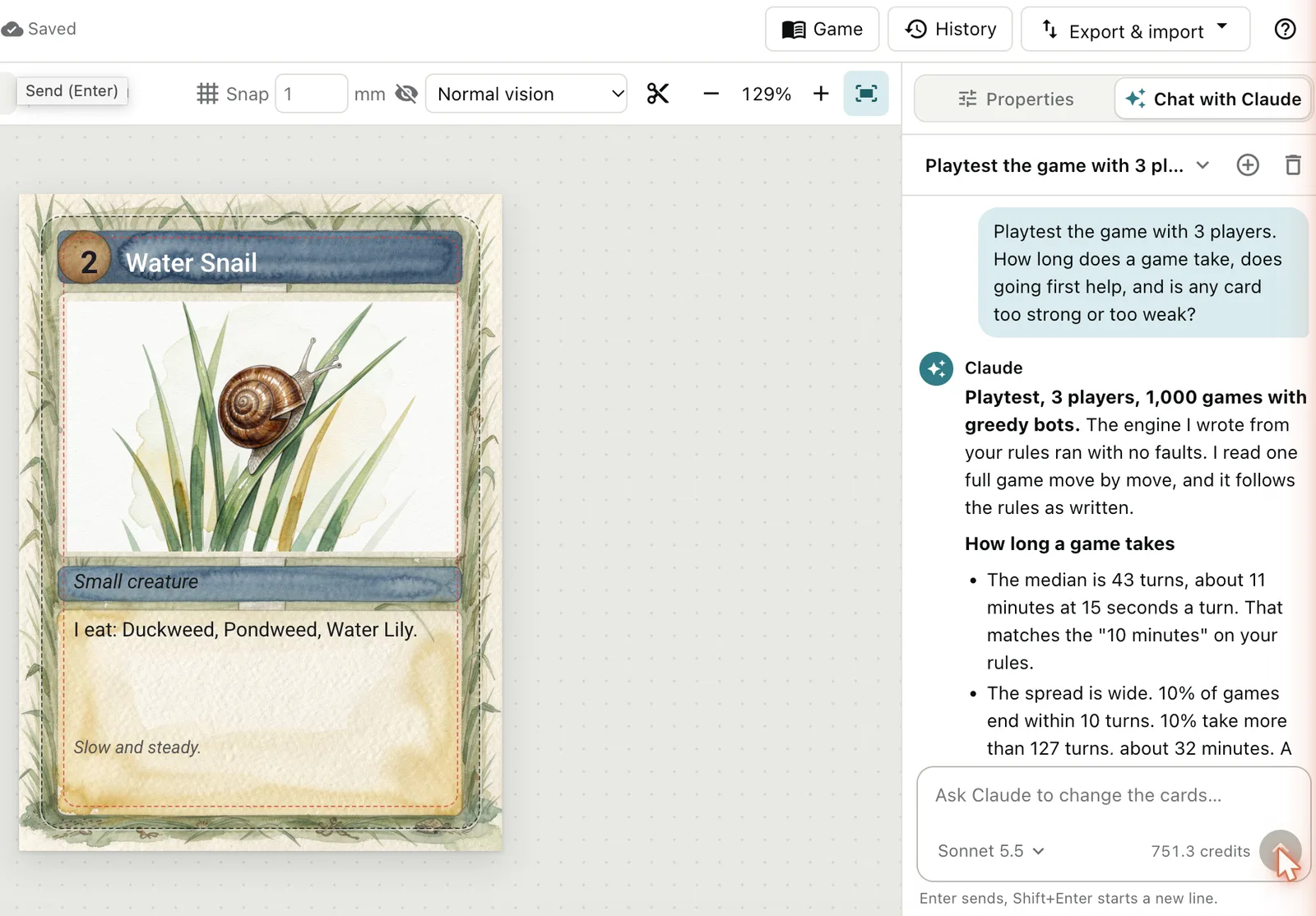
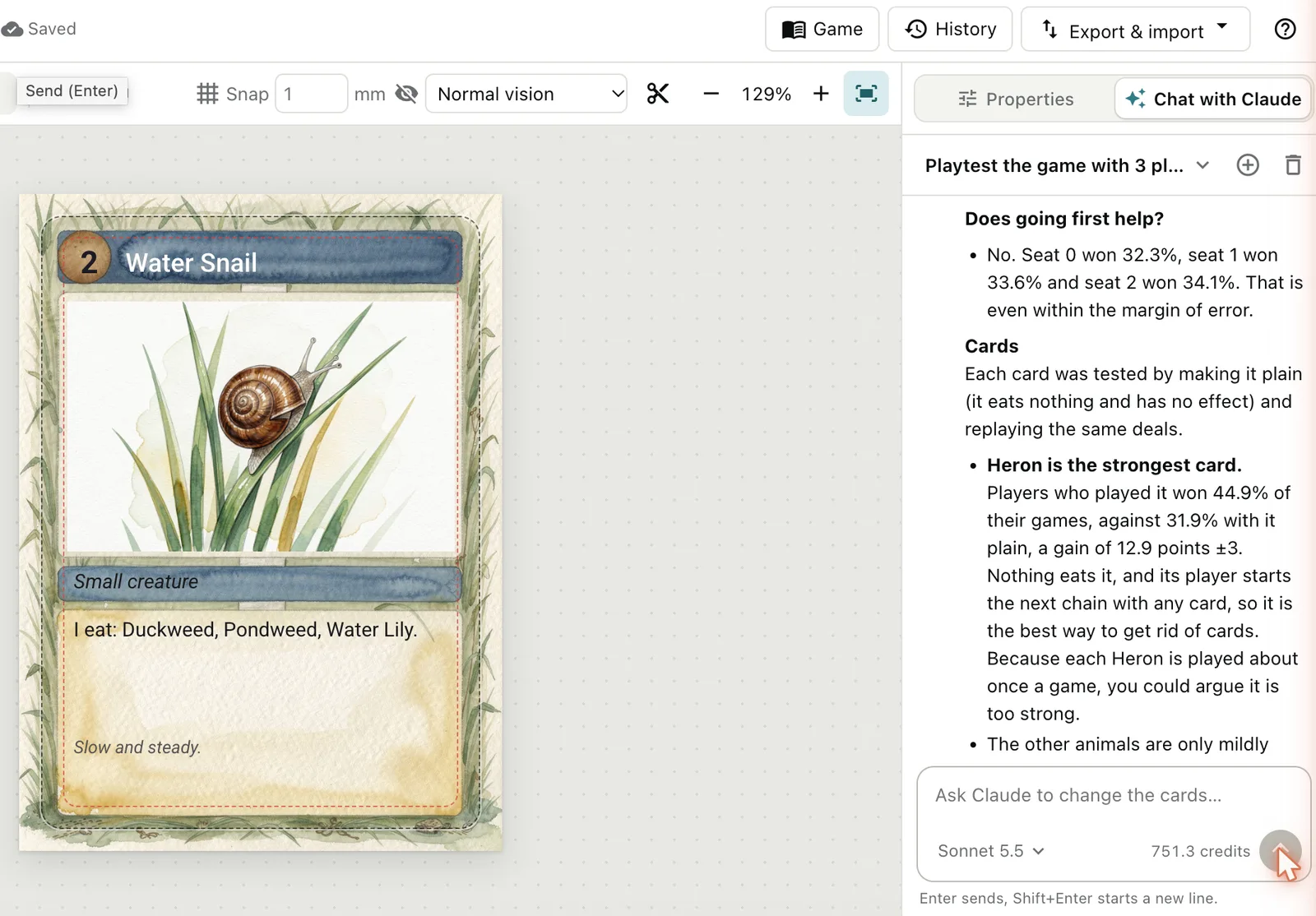
A card's strength is measured by replaying the same deals with that card made plain, so luck in the deal does not count. When something looks off, Claude suggests a few fixes and tries them on the same deals before it suggests them; “try that fix” is the next message.
A playtest says whether a game plays to an end, how long it takes, how much skill counts against luck, and whether a seat or a card decides it. It cannot say whether a game is fun: that still takes people at a table, with the print-and-play PDF or in Tabletop Simulator. Games that are mostly talk, bluffing, dexterity or storytelling get only a reading of their rules.
Questions you may have
Is the game still mine?
Yes. It is a project in your account like any other: every card, picture and rule can be changed by hand, and the whole project can be exported and taken elsewhere.
Can I use Claude for only part of it?
Yes. Use the chat only for the tedious parts, or only for a playtest. Nothing is changed unless you ask for it.
What is sent to Claude?
What Claude needs for what you ask: the project's cards, rules and pictures. Who it goes to, and what they may do with it, is in the privacy policy.
I already pay for Claude. Can I use that?
Yes: connect it to Card-a-mon on your account page. It works on the same projects, and your own subscription pays for its work, not AI credits.
Questions or ideas: info@cardamon.lt.